


For SHE Managers & Safety Leaders:
The Case for Doing Emergency Preparedness Better — and Spending Less Doing It
Get your own Action-cards® in our webshop now:
Your organisation may be fully compliant and still be unprepared.
Most safety systems measure training completion. Emergencies measure performance.
Those are not the same thing. You did not get into safety to tick boxes. You got into it because you wanted people to go home unharmed. And you know the difference between a workplace that is genuinely ready and one that merely looks ready on paper.
So here is the question worth sitting with: is your current setup actually working? Not in the records. In practice. When it matters.
The Training Investment That Keeps Losing Value
Most organisations run the same playbook: a course, a certificate, a file note — repeat next year. That is not a criticism. It is just not enough.
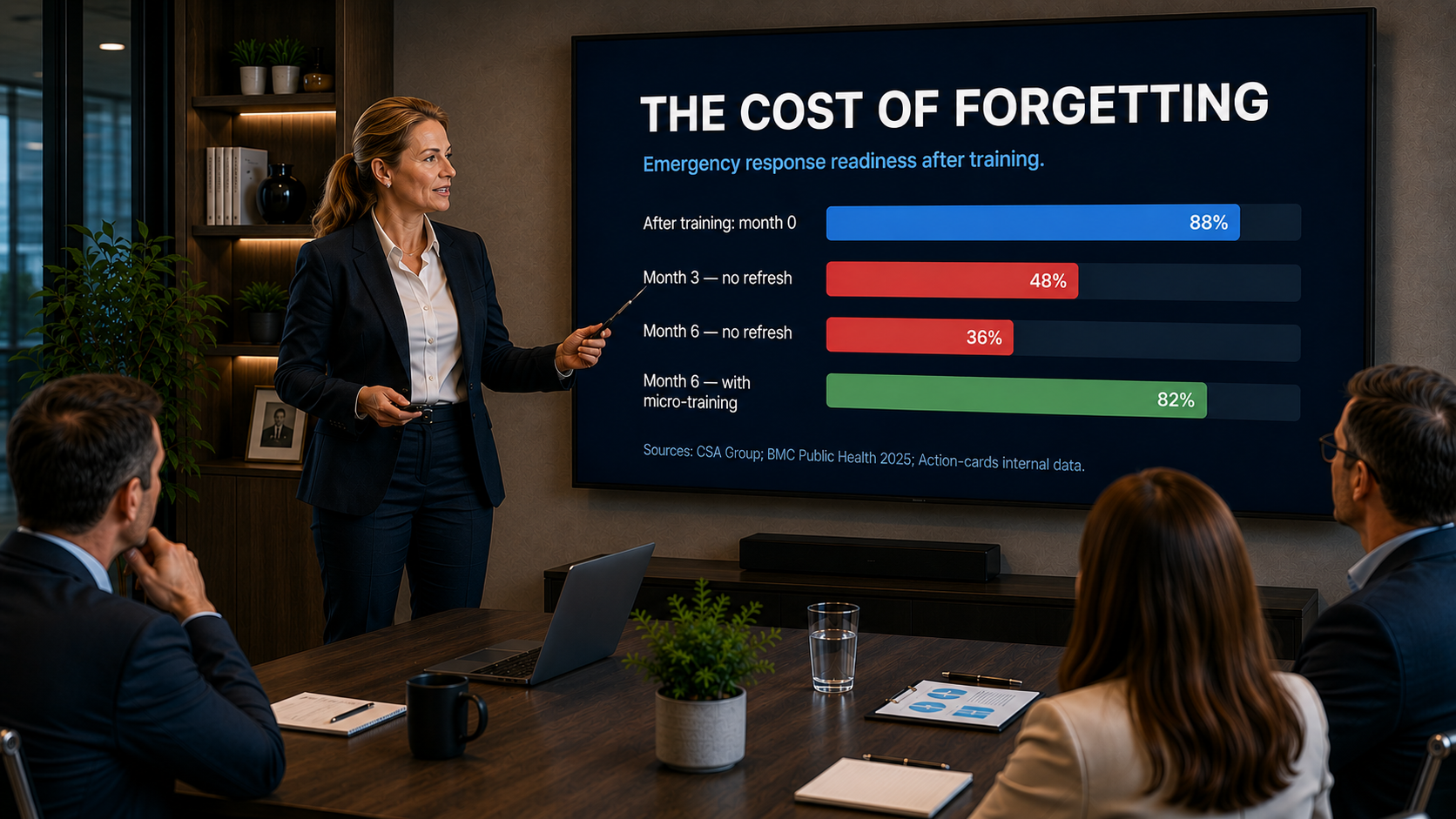
People forget. That is not a flaw — it is how humans work. Research from the CSA Group shows emergency response skills start declining less than six months after training.(1).
A 2025 study in BMC Public Health confirmed that performance rates of 74–90% right after a course fall sharply within six to eight months.(2).
Then add stress. When something actually goes wrong, people panic, tunnel-vision sets in, and memory becomes unreliable(3).
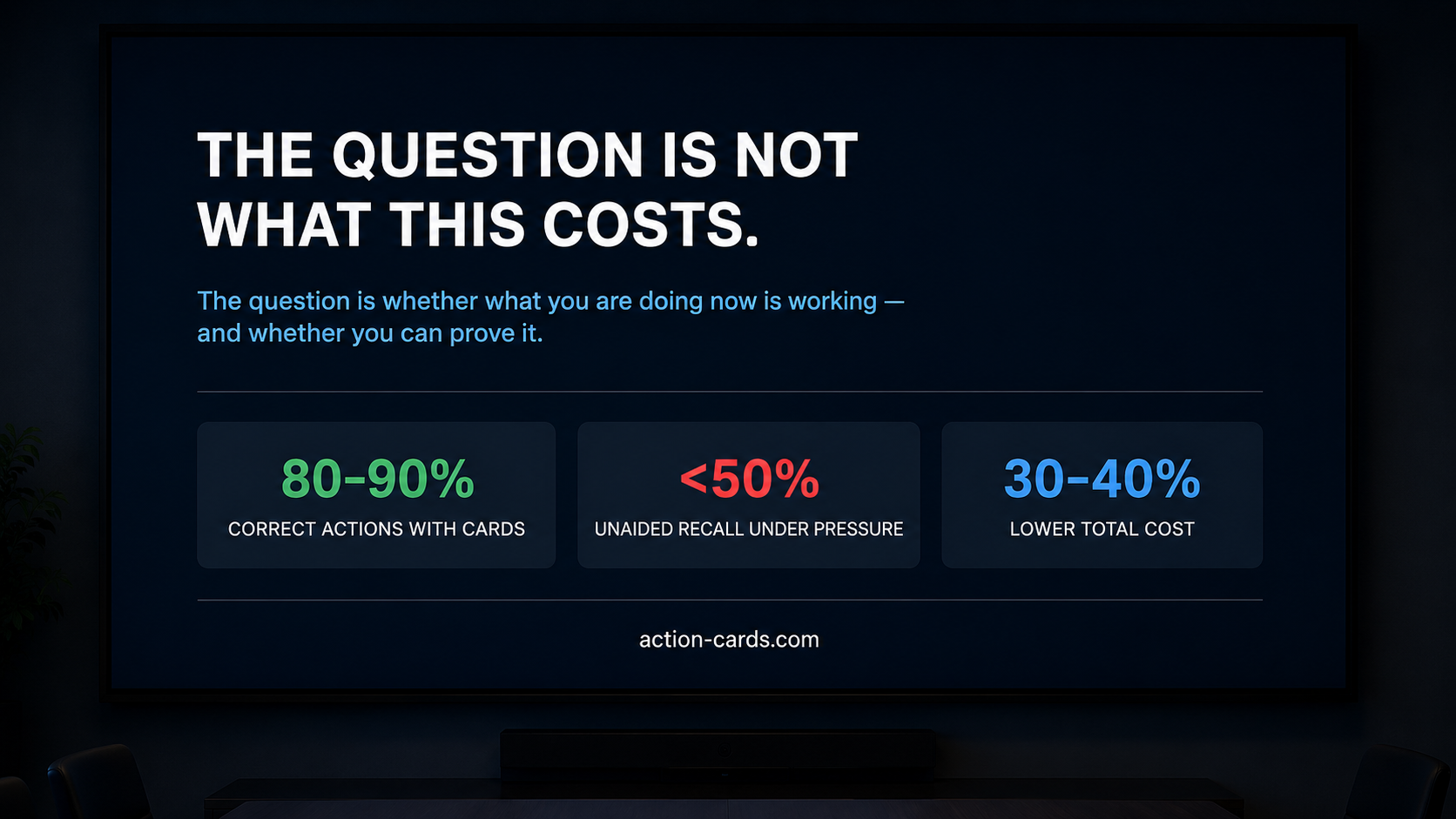
Unaided recall in real emergencies frequently drops below 50% for correct responses. Not because people did not try. Because the system set them up to rely on memory alone — in exactly the moments when memory fails.
What This Costs — in Every Sense
You carry this in two ways. The first is the one that keeps you up at night: an incident that escalates further than it should because the first response was too slow or simply wrong.
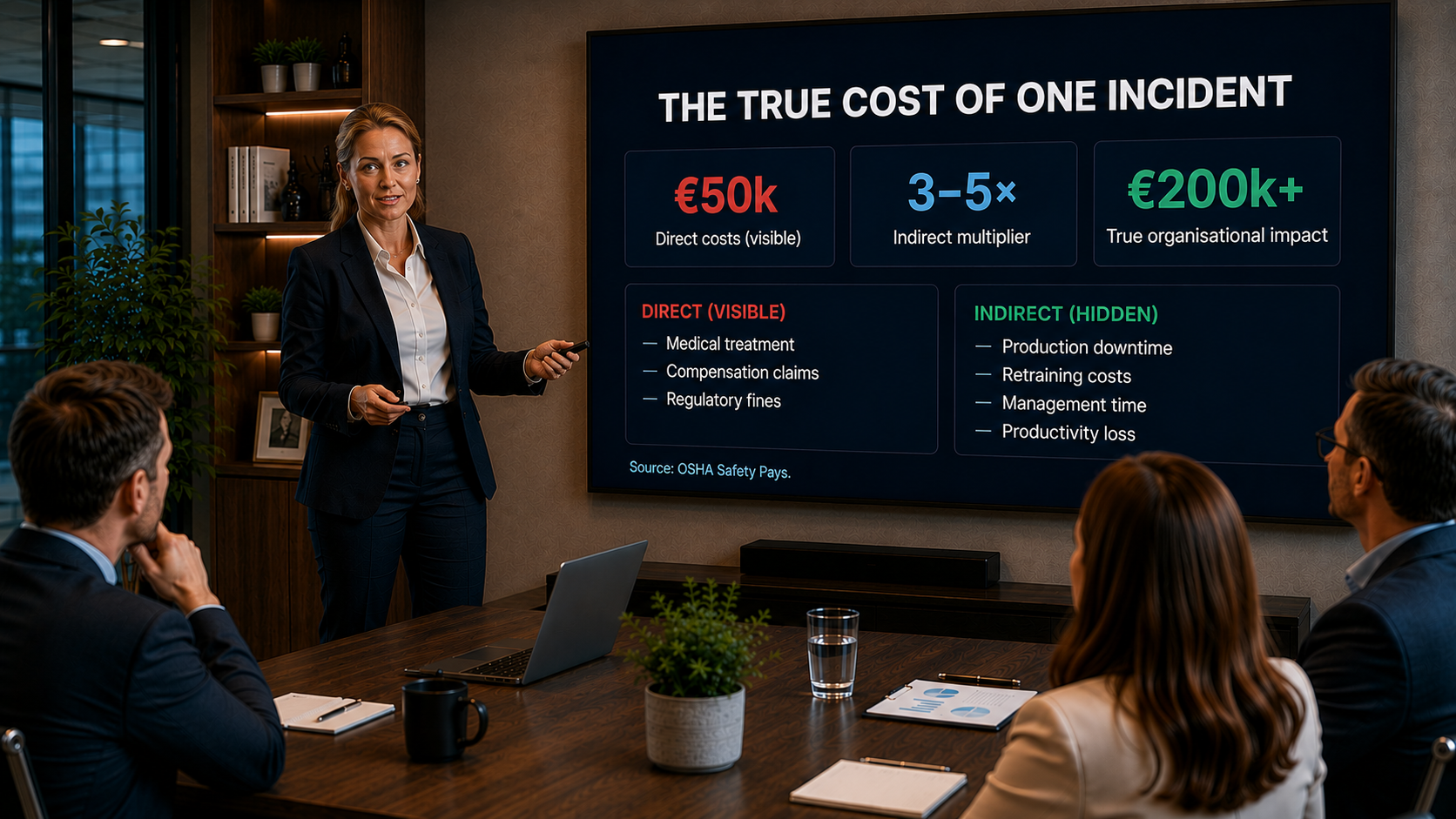
The second matters in budget conversations. OSHA — the US workplace safety authority — finds that indirect costs of workplace incidents (downtime, retraining, management time) are typically 3 to 5 times higher than the direct costs(4).
An incident with €50,000 in visible costs may carry a true impact exceeding €200,000.
Better real-world readiness at 30–40% lower total cost does not just save money. It frees resources for more safety. That is not a trade-off — that is a better outcome by every measure.

Better real-world readiness at 30–40% lower total cost does not just save money. It frees resources for more safety. That is not a trade-off — that is a better outcome by every measure.
The Problem With Leaving It to the Designated Few
Many larger organisations rely on a small group of trained emergency responders. Reasonable — but it rests on an assumption that rarely gets tested: that the right person will be there when it matters.
Availability is not a guarantee. It is a variable.
Think about what available actually means across a normal week. Lunch. A different floor. A client meeting. Off sick. On leave. Covering another site. Phone on silent. None of these are exceptional. They are Tuesday.
And in organisations covering multiple shifts or locations, there will be stretches — possibly regular ones — where the effective emergency response capability of the whole organisation is close to zero.
Most organisations cannot answer a simple question: right now, how far away is the nearest person who could respond correctly? For many, the honest answer is: we do not know.
When minutes matter, proximity is not enough.
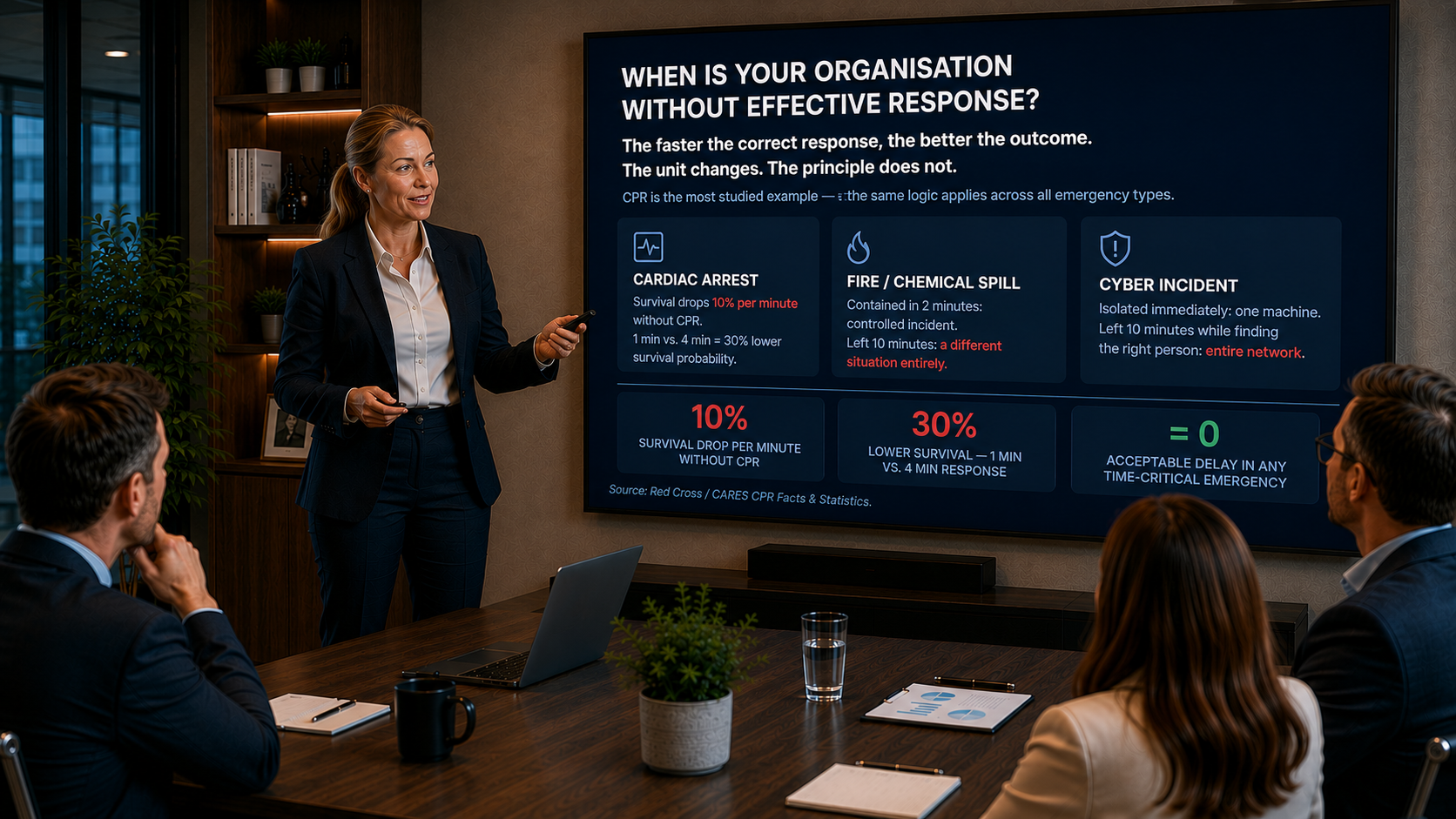
Even when the designated person is nearby, the time cost can be unacceptable. Cardiopulmonary resuscitation (CPR) research makes the principle stark: survival chances drop by 10% for every minute without CPR.(5)
The gap between a one-minute and a four-minute response is not a planning detail — it is a 30% reduction in survival probability.(6)
CPR is the most studied example. But the principle holds across every time-critical emergency. A chemical spill contained in two minutes causes a fraction of the damage of one left for ten.
A cyber incident isolated immediately affects one machine; left for ten minutes while someone locates the right person, it can compromise an entire network. The unit changes. The principle does not.
Designating a few gives everyone else permission to wait.
There is one more problem, and it is a subtle one. When a few people are designated as responders, everyone else quietly assumes that is not their job. Psychologists call this the Bystander Effect.(7)
Responsibility diffuses. Nobody acts. A distributed model — where everyone has the tools and the confidence to respond — breaks that dynamic.
Action-cards® does not replace the specialist. It makes sure that whoever is actually there in the first critical minutes can act correctly, while the specialist is on the way.
Most organisations cannot answer a simple question: right now, how far away is the nearest person who could respond correctly? For many, the honest answer is: we do not know.
A Systemic Solution
Action-cards® are durable, physical emergency response cards — waterproof, shock-resistant, no app required — that walk any employee through the right response, step by step, across more than 30 scenario types.
From first aid and industrial incidents to IT and cyber emergency emergencies, developed with digital security specialists.
Internal data shows employees using the cards in realistic drills achieve correct response rates of 80–90%

Without them, relying on memory under pressure, that figure routinely falls below 50%.
The cards are not just for real incidents — they are the guide for training too. Because the correct steps are already on the card, any team leader can run a 10–15 minute scenario session themselves.
No external instructor. No scheduling. No separate budget line. Built into the working week, not bolted on top of it.
AC-Analytics
AC-Analytics (action-cards.com/en/ac-analytics)
is where most organisations discover how much they have been flying blind. Most know who attended a course. Very few know who continues to practise — or how their team actually performs.
AC-Analytics closes that gap. Every QR scan automatically logs time, user, and action, building dashboards that show skill gaps, near-miss patterns, and readiness trends across teams and locations.
Exportable for compliance, CSR, and insurance in minutes. Your competitors offer training and certification. This offers visibility.
Most organisations cannot answer a simple question: at any given moment, how far away is the nearest person with the tools and confidence to respond correctly? For many, the honest answer is: we do not know. And on some days, the answer would be uncomfortable.
From Framework to Floor
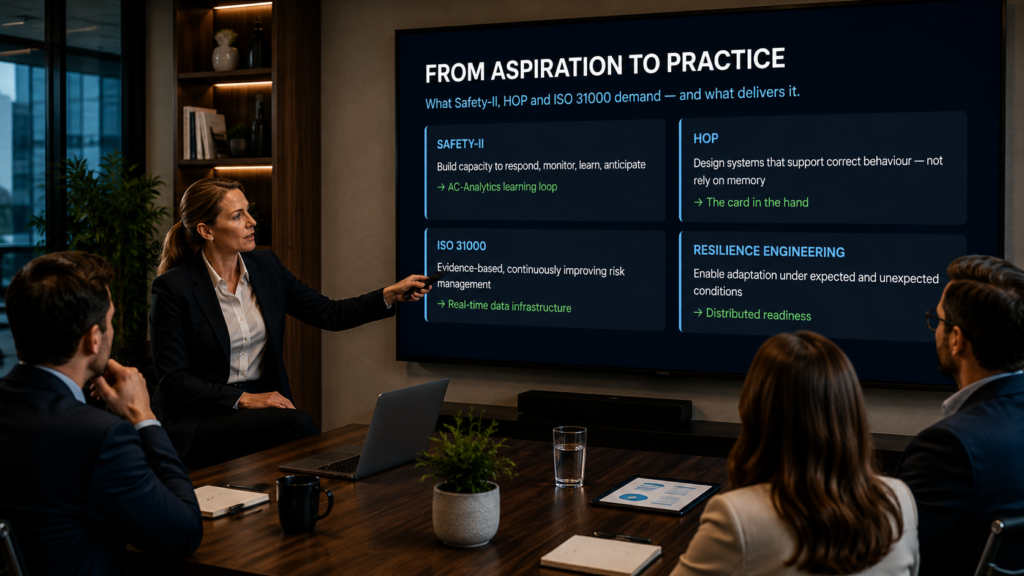
If your organisation is working with Safety-II, HOP, Resilience Engineering, or ISO 31000, you already know the frustration: the frameworks make sense, but getting them to live at the level where emergencies actually happen is genuinely hard.
What all of them share is a common ask: design systems that support correct behaviour rather than relying on perfect human recall; build capacity to respond, learn, and improve continuously; make safety management evidence-based, not just documented.
Action-cards® is what that looks like in practice. The cards redesign the context so the right action is supported in the moment — which is precisely what HOP prescribes. AC-Analytics provides the monitoring, near-miss logging, and learning loop that Safety-II and ISO 31000 call for.
If the gap between framework aspiration and daily reality has been a source of frustration, this is one of the more direct ways to close it.
The Practical Question
You are responsible for what happens when something goes wrong — whether that is a colleague in medical distress, a fire that spreads further than it should, or a cyber incident that escalates because no one knew the right first step. That responsibility does not end when the certificate is filed.
You are not asking for more money. You are proposing to spend existing money better — to get more preparedness, better documentation, and measurable outcomes across more risk areas, for less.
The question is not whether this costs more than what you are doing now. It almost certainly does not. The question is whether what you are doing now is actually working — and whether you can prove it.
Note:
Action-cards® data on correct action rates (80–90% with cards vs. below 50% unaided) is based on internal performance data collected across customer implementations in realistic training scenarios
Notes
1 CSA Group, First Aid Training and CPR Skills Retention — csagroup.org
2 BMC Public Health, Skill retention after school-based CPR training – a systematic review and meta-analysis (2025) — bmcpublichealth.biomedcentral.com
3 Regehr & LeBlanc, PTSD, Acute Stress, Performance and Decision-Making in Emergency Service Workers, Journal of the American Academy of Psychiatry and the Law (2017); and: Decision-Making During High-Risk Events: A Systematic Literature Review, PMC (2023)
4 OSHA, Safety Pays — Background — osha.gov/safetypays/background
5 Recent advances and controversies in adult cardiopulmonary resuscitation, PMC — pmc.ncbi.nlm.nih.gov/articles/PMC2600120
6 Red Cross / CARES, CPR Facts and Statistics — redcross.org
7 St John Ambulance, From bystander to first responder – the psychology of emergency response — sja.org.uk