


A different way to think about team building
for the manager who runs a team and wants it to hold together when it matters. Emergency readiness is the reason to run it. A team that works better together is what you keep.
Get your own Action-cards® in our webshop now:
In August 2015, a pound on Leicester City to win the Premier League paid 5,000 to 1 — the longest odds in the division by a distance. Fifteenth-highest wage bill in the league. No superstars. Nine months later they were champions, ten points clear of Arsenal.
Ask how they did it and you get the same answer in different words: they weren’t the most talented eleven, they were the most rehearsed. N’Golo Kanté, signed for a fraction of what the big clubs spent, led the league in tackles and interceptions — not because he was the most gifted player in England, but because he did one job, over and over, and ten other men knew exactly what he’d do and moved around it. A team far greater than the sum of its parts.
Hold that thought, and walk out onto a warehouse floor.
It’s Friday afternoon. You’re in a meeting two buildings away. Out among the racking, one of your people buckles — grabs at a pallet rack, slides down it, and stays down. The three colleagues standing closest aren’t trained in anything in particular. They’re just the ones who happen to be there. And for the next forty seconds, nothing happens. Not because they don’t care — the opposite. Because none of them knows whether it’s their job to move. One looks at another. The other glances at the door, where the supervisor usually stands. The supervisor is off today.
You weren’t there. That’s the whole point. You’re almost never there when it counts.
So here’s the case I want to make. Most companies prepare for an emergency around a person who, almost by definition, is somewhere else: the manager, the designated first aider, the one with the certificate who’s on lunch upstairs. It’s a system that depends on your star striker being on the pitch at the exact moment the ball breaks loose. The fix — training the whole team to hold the roles between them — quietly turns out to be the most useful team building you’ll ever run. Readiness is the reason you do it. A team that works better together is the part nobody prints on the invoice.
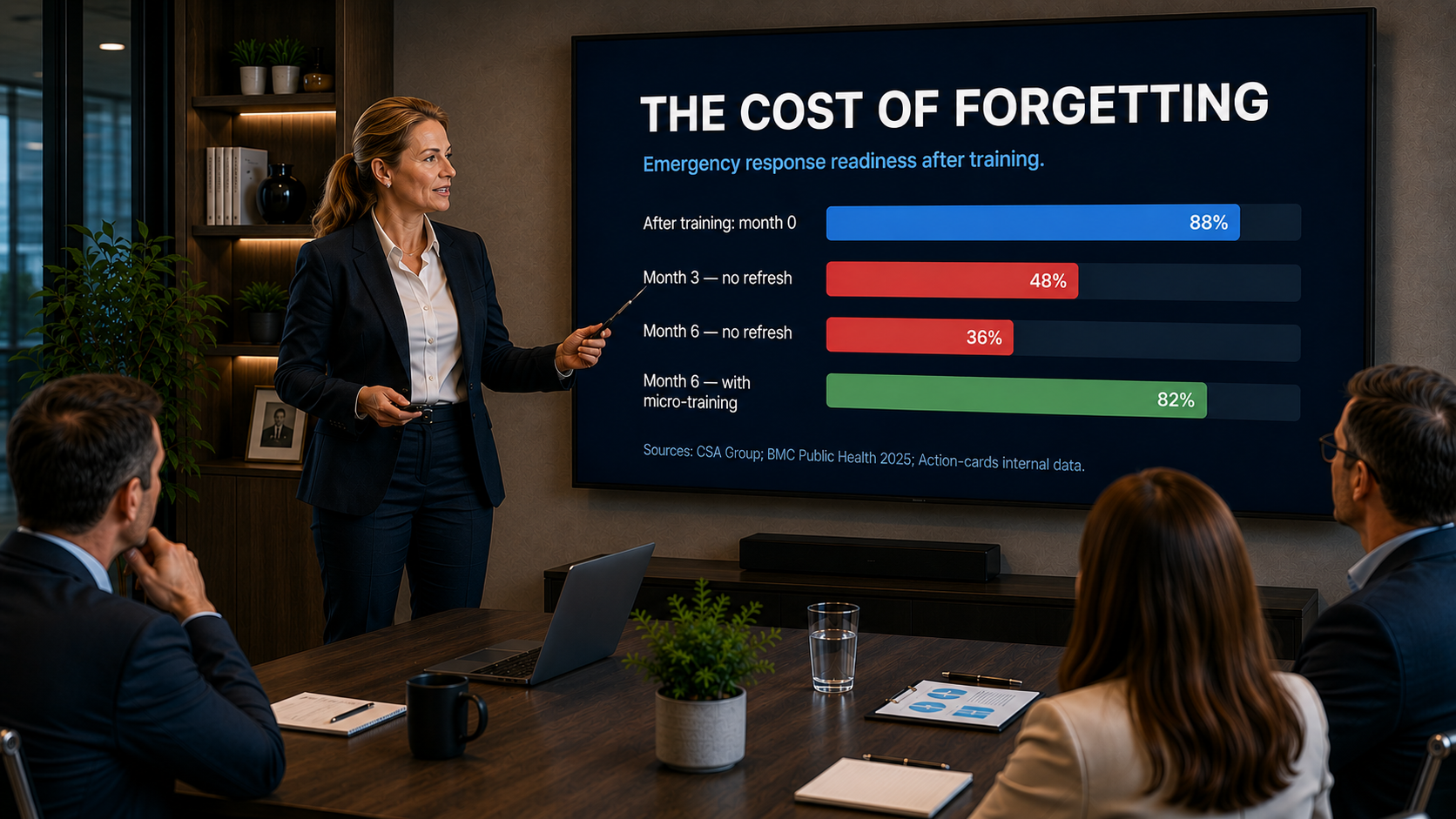
The person closest is never the boss
We organise emergency response as if help arrives from the top. Reality on the floor runs the other way. The person closest to a colleague who collapses is another colleague — not the manager, and not the one with the certificate. And there’s a well-documented reason those first seconds so often dissolve into silence.
In 1968, two psychologists, John Darley and Bibb Latané, staged it in a lab. Students believed they were in a group discussion over an intercom when one voice appeared to have a seizure. Alone, 85% went for help, quickly. In a six-person group, only 31% did — and the average response took 166 seconds, nearly three minutes. Same people, same emergency. The one thing that changed was how many others they believed were present. They called it diffusion of responsibility: the more people around, the thinner each person’s sense that acting is their job specifically.
This is an entirely normal reaction from a team that never agreed, in advance, who does what. And you can train your way out of it.
What you built in the escape room stayed in the escape room
Most companies have tried team building. Go-karting, an escape room, a day in the woods with ropes and barrels. People enjoy it, and there’s nothing wrong with that — a team that has laughed together does feel better on Monday.
But by Monday, not much is left. What the team learned about working under pressure in the escape room stayed in the escape room. It never made it back onto the floor, because it was never about anything that looked like the floor.
This is the Leicester point, turned around. Collaboration sticks when it’s trained around something that matters, in something that resembles the real thing. Footballers don’t build their understanding at the go-kart track; they build it running the same moves, in the same roles, until the pattern holds under pressure.
You don’t rise to the occasion. You fall to the level of your training. A warehouse is not a football pitch, and we won’t pretend the stakes rhyme neatly — but the mechanism is the same: a group becomes a team by rehearsing the hard part together, not the fun part.
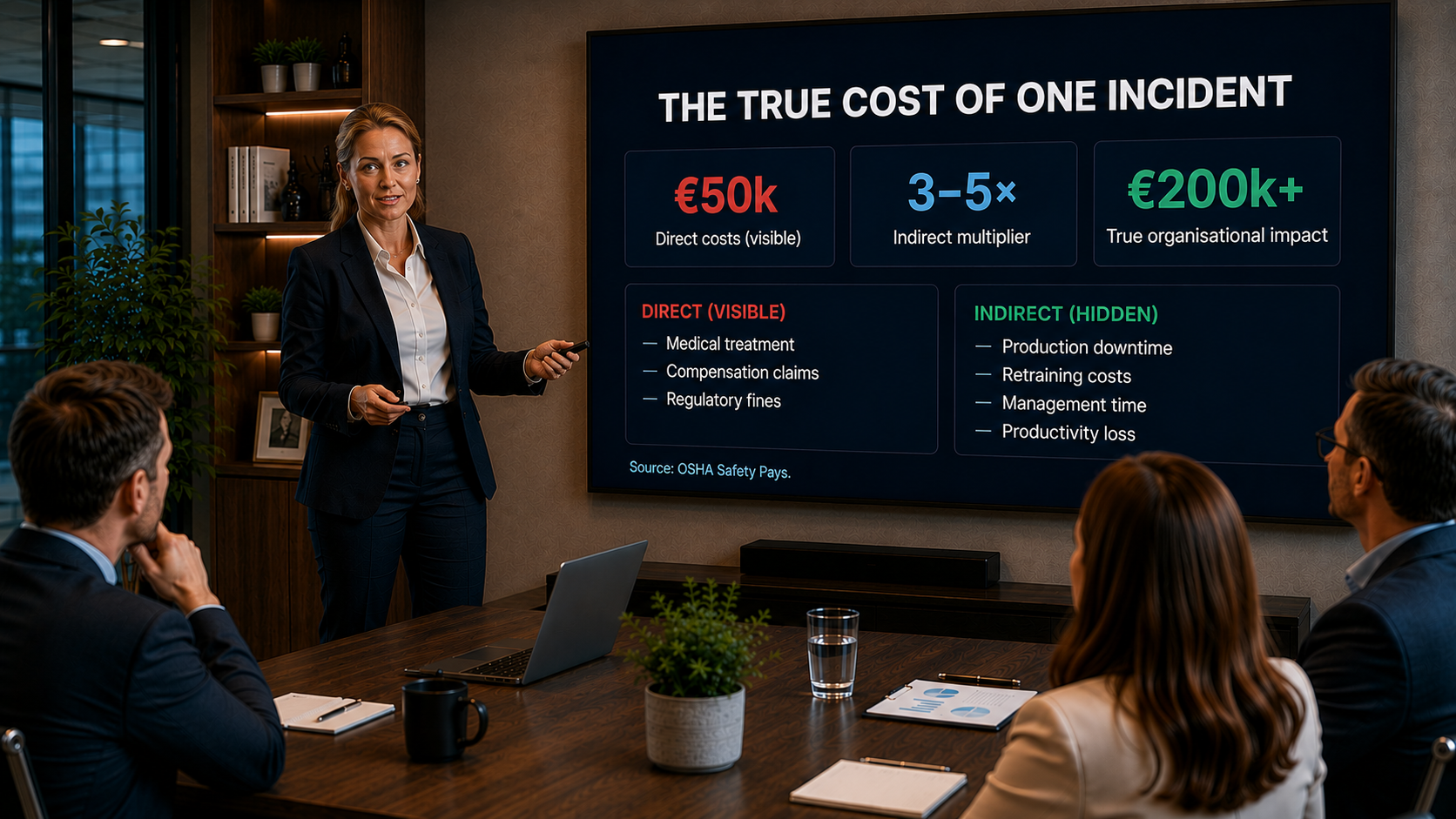

Better real-world readiness at 30–40% lower total cost does not just save money. It frees resources for more safety. That is not a trade-off — that is a better outcome by every measure.
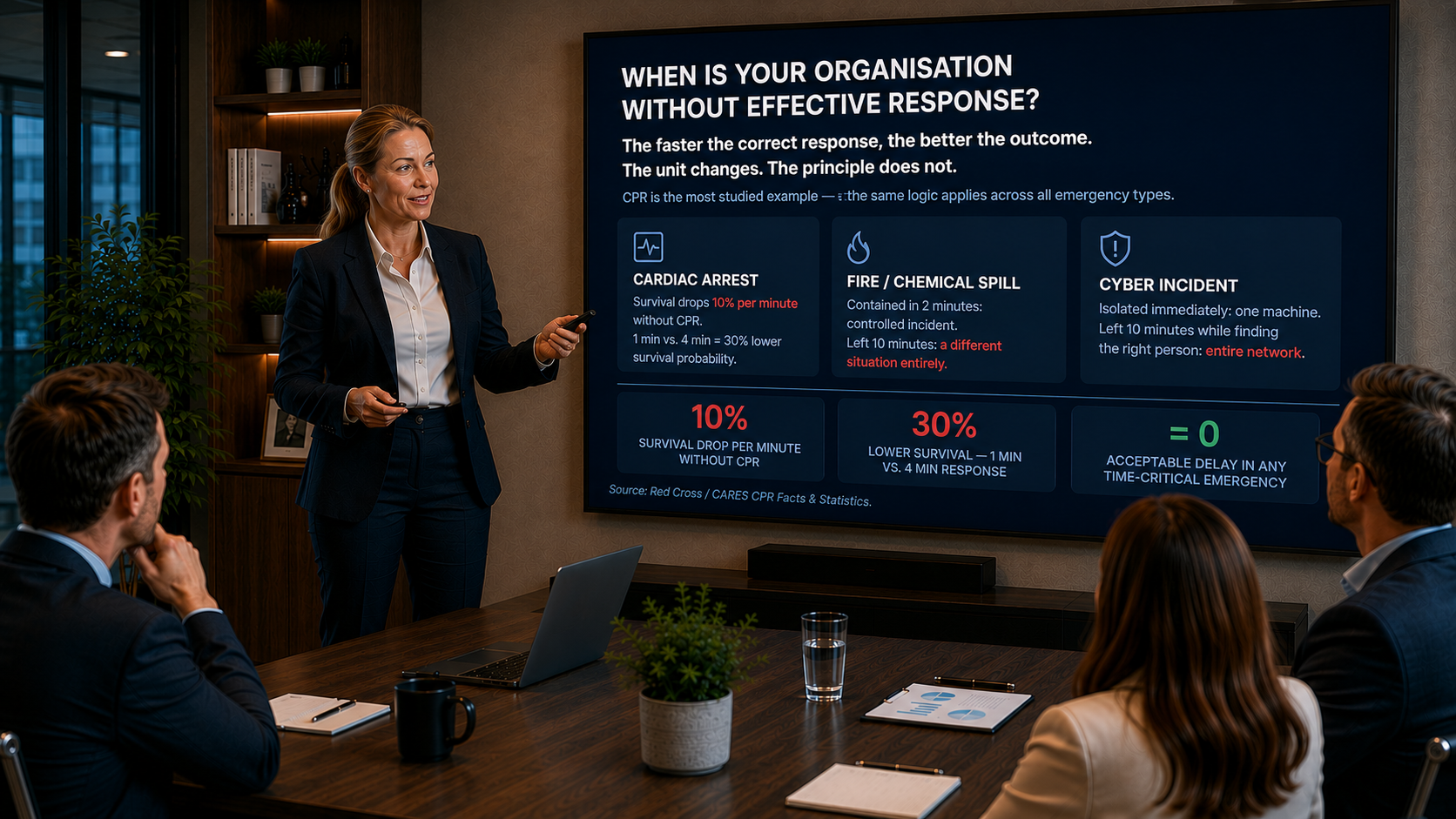
An exercise that looks like the real thing — and takes fifteen minutes
So picture this instead. The team gets fifteen minutes on a Tuesday. No bus, no instructor, no one caught out in an exam. On the table is a set of rugged cards, one scenario at a time: a colleague has collapsed, a hand is caught in a machine, a machine has caught fire. One person reads aloud what needs to happen, step by step. One acts. One calls emergency services and says the address out loud. Then you swap roles and run it again.
The card holds the details, so the team can spend its attention on the hard part — talking to each other, sharing out the roles, and daring to take the first step. That is where the collaboration training happens: not in spite of the serious content, but because of it. To make the exercise work at all, the team has to communicate clearly, trust each other, and let someone lead and back them up.
The cards earn their place on the evidence. When even certified responders work from memory alone, the critical steps come apart: a 2011 study of 257 workplace first responders (Anderson, Gaetz and Masse, Scandinavian Journal of Trauma, Resuscitation and Emergency Medicine) found core skills performed poorly regardless of how recently people had trained. With a step-by-step card in hand, Action-Cards’ own implementation data puts correct performance at 80 to 90%.^*^
The team doesn’t need to remember everything. It needs to be able to find it — together, in the moment.
What your team takes home
Now the part that stays with the team — in a currency you’ll recognise.
A team that has trained the hard part together is calmer in ordinary work. People who have stood in a pressured situation side by side — even a rehearsed one — talk more easily about everything else afterwards: the shift rota, the mistake on the night shift, the new colleague who’s still a little on the outside. Confidence rubs off on the tone. And a team that knows it can look after each other tends to look after each other better.
Your people also walk away able to do something that matters — not only at work, but at the football pitch, the campsite, at home the evening it counts. That’s a pride people carry with them. And it cost you fifteen minutes, not a full day with a coach and catering.
The team-building budget often already exists. This is simply a better way to spend it.
I actually booked it for safety’s sake. But what I took home was a better team. Within the first fifteen minutes I could feel my people standing closer together — they took responsibility, they backed each other up, and they talked more easily about everything else afterwards. I’ve spent far more money on team building that was forgotten by Monday morning. This one stuck — and one day it might save one of us.
You don't have to wait for a course
The good part is that you can set it in motion yourself — not a procurement cycle, not next year’s plan. If you have a team, you already have most of what you need: a few cards, fifteen minutes, and the will to try it. Your health-and-safety rep is the obvious ally for getting it into the rhythm, but it starts with you, the one who has the team.
Remember that Leicester didn’t win because they signed the best player. They won because eleven people rehearsed one hard thing until they could do it without looking. Your team can have that too. And the day it matters, it won’t be you standing closest. It’ll be them.
Want to see how fifteen minutes on a Tuesday is actually put together? Get in touch, and we’ll walk you through one.
Feel free to share it with the team — it’s about them, too.
* Figures are drawn from Action-Cards’ own customer implementations and have not been peer-reviewed.
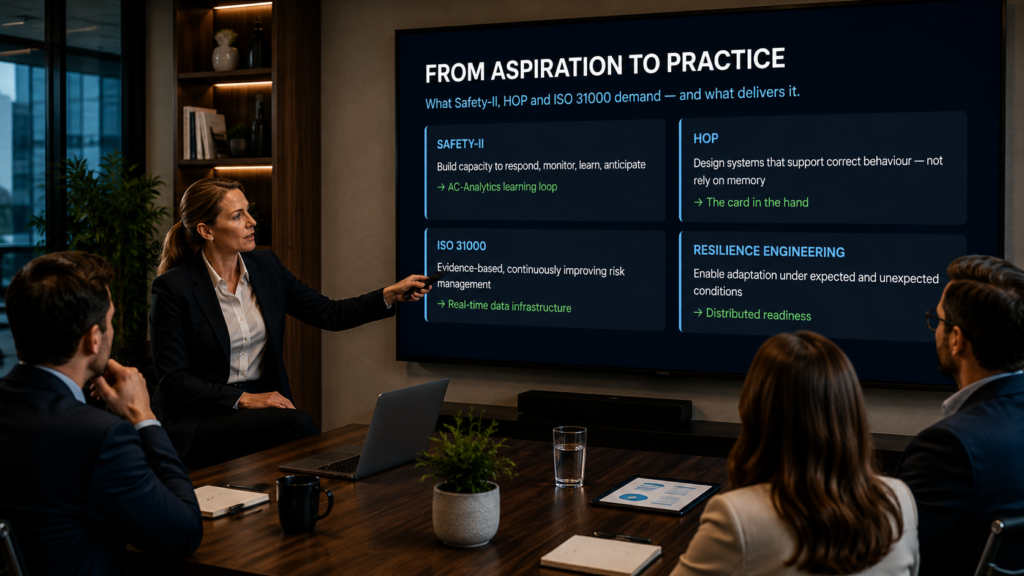
About Action-Cards®
Action-Cards® are physical emergency response card sets with built-in QR incident reporting and AC-Analytics® integration. Schedule a conversation with the team.