



For CLO's:
Compliant on Paper.
Defensible in Court?
Two Very Different Things.
Get your own Action-cards® in our webshop now:
Your organisation almost certainly meets the minimum legal requirements for workplace safety training. The annual course has been run. The certificates are on file. The boxes are ticked.
The harder question — one that surfaces only after a serious incident — is whether any of that would hold up under scrutiny. Not in the records. In a courtroom. Before a regulator. In front of the board.
Compliance and legal defensibility are not the same thing. This piece explains the gap — and why Action-cards® and AC-Analytics close it in a way that a certificate filed in a drawer simply cannot.


A certificate proves attendance. It does not prove capability. In litigation, that distinction is everything.
— On the limits of annual training documentation
Duty of Care Goes Further Than You Think
The familiar legal obligation is straightforward: provide adequate first aid training and equipment, renew annually. In most jurisdictions, that is the baseline.
But courts and regulators increasingly ask a second question: not just whether training was provided, but whether the employer took reasonable steps to ensure it remained effective. That is a much higher bar.
Research consistently shows emergency response skills degrade within weeks of training, with significant deterioration inside six months.1,4 The effect is measurable at the level of individual actions: in a study of 257 paid workplace first responders, fewer than 50% of the critical steps in an emergency scenario were performed correctly — even among those trained within the previous 30 days.5 With a card in hand, correct action rates in realistic scenarios run at 80–90%. A worker who attended a certified course eleven months ago cannot be assumed to perform the protocol they were taught. If they respond incorrectly in an emergency, the question becomes: what did the employer do to maintain preparedness between certifications? If the answer is “nothing”, the certificate is a paper shield. It looks like protection. It will not hold.
The Paper Shield
What Your Certificate Actually Proves
A certificate proves one thing: that an employee attended a course on a specific date. It says nothing about whether they could perform correctly today — under pressure, in an emergency they haven’t practised for since.
In a post-incident investigation or civil claim, that distinction is precisely what gets examined. The question is not whether training happened. It is whether the employer took reasonable, documented steps to maintain preparedness continuously.

The Paper Shield vs. Documented Preparedness
Annual Certificate Only
- Proves attendance on one day per year
- No evidence of ongoing capability
- No record of who trained when, or how recently
- Skill decay goes undocumented and unaddressed
- Difficult to defend in post-incident investigation
Action-cards® + AC-Analytics
- Timestamped record of every micro-training session
- Individual and team readiness scores in real time
- Automated audit trail across all emergency types
- Identifies and flags skill gaps before incidents occur
- Defensible documentation of continuous preparedness
The First Five Minutes Are a Legal Event
When a serious incident occurs, the emergency response itself becomes evidence. Investigators, insurers, and plaintiff attorneys will want to know exactly what happened, in what order, and why — and will compare it against what a properly prepared employee should have done.
Action-cards® provide a documented, standardised protocol for every employee, every time. When employees follow that protocol — and have trained on it repeatedly through micro-sessions logged in AC-Analytics — there is a timestamped record that the standard was not merely stated but actively maintained. That record satisfies auditors, shapes insurance conversations, and is the difference between saying “we had a training programme” and being able to prove what it delivered.
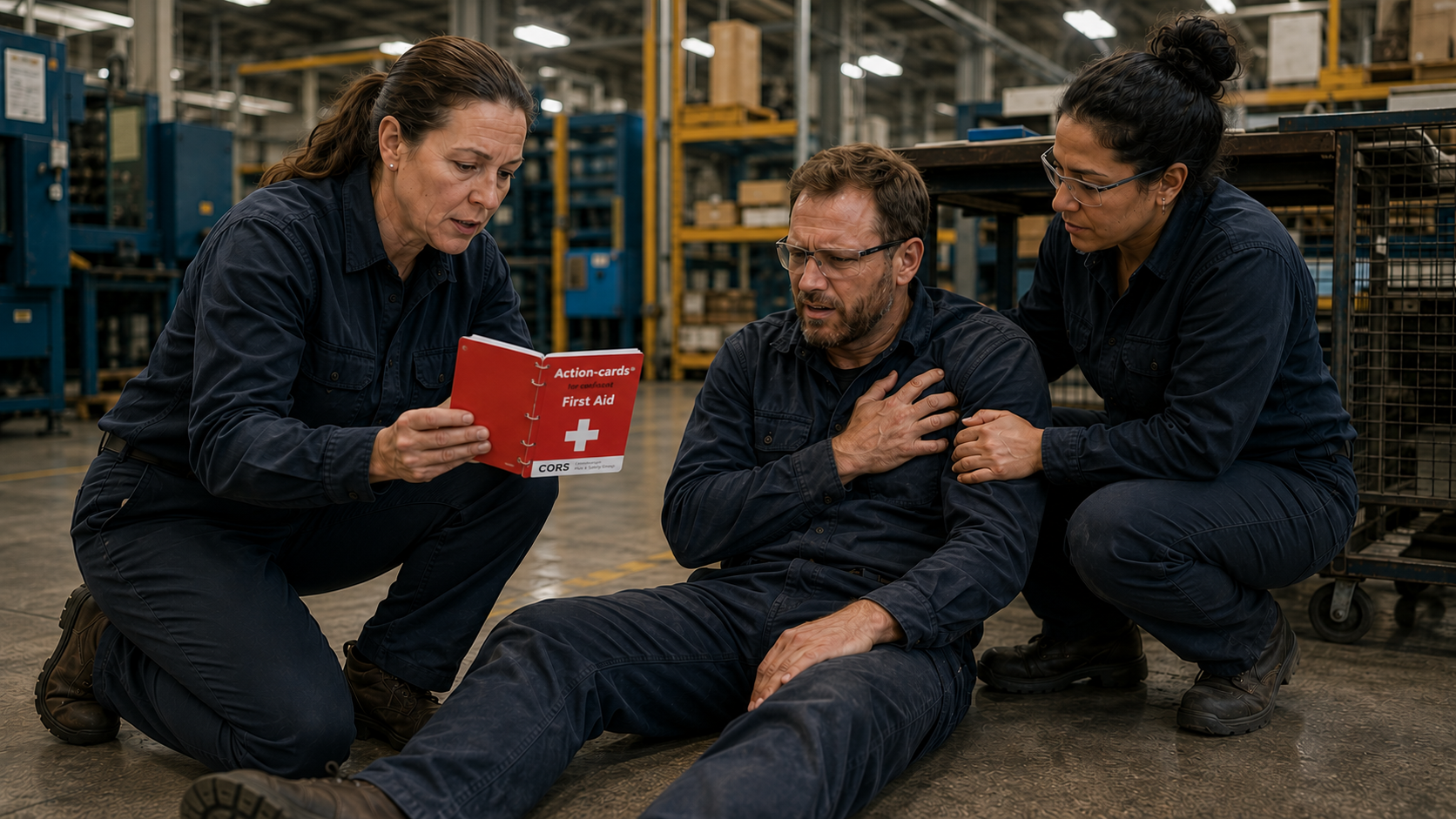
In almost every post-incident review we conduct, the organisation had training on paper. What they did not have was evidence that it was current, consistent, or retained. That gap — between what was purchased and what was practised — is where legal exposure lives.
— Perspective from emergency preparedness practitioners
It Is Not Just First Aid
The legal exposure most CLOs focus on is physical injury. But the scope of emergency risk in a modern organisation is wider, and the documentation requirements follow the same logic across all of it.
First Aid & Medical
HSE
Workplace First Aid Regulations
+ duty of care obligations
Cyber Incidents
GDPR
72-hr breach reporting window
+ documented response procedures
Fire & Evacuation
FSO
Fire Safety Order / local fire code
+ documented warden training
Action-cards® cover the full range: cardiac arrest, fire, chemical exposure, machinery breakdown, cyber incidents. A single integrated system producing auditable evidence across all emergency types is considerably stronger — legally and operationally — than a patchwork of separate courses and separate records.
AC-Analytics
Evidence Infrastructure, Not Just a Training Tool
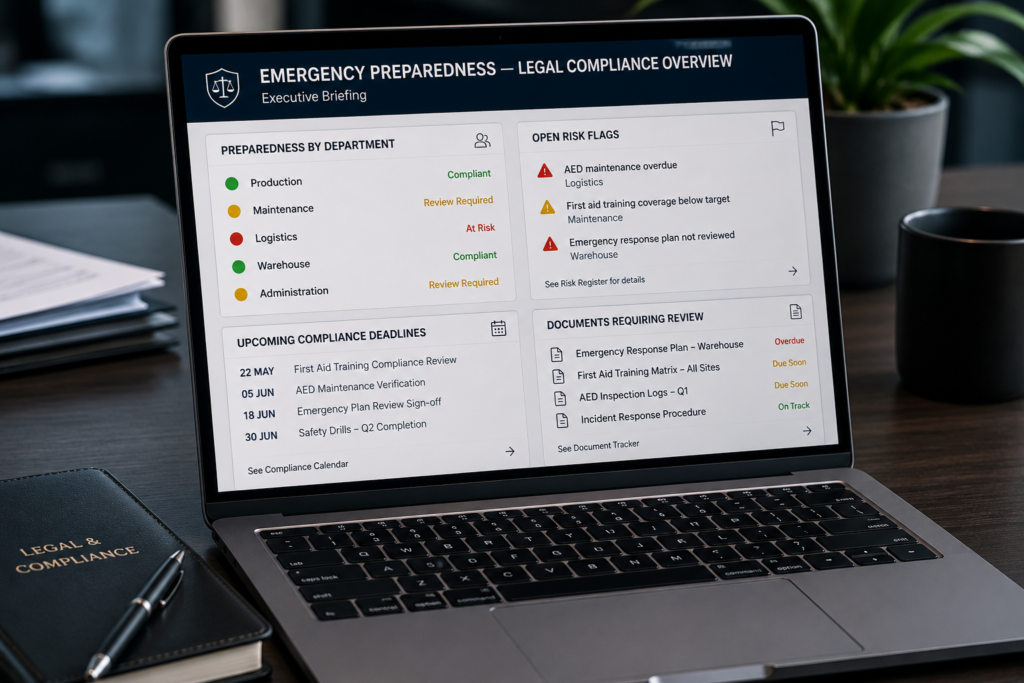
AC-Analytics automatically logs every training session, every QR scan, every incident report and near-miss — building a continuous, timestamped record of your organisation’s preparedness.
For a CLO, this is not a safety feature. It is a legal asset: structured documentation producible on demand for a regulator, insurer, auditor, or court. The data exists because the system generates it — not because someone remembered to file it.
The Regulatory Horizon Is Moving
Across the EU, UK, US, and most OECD jurisdictions, the trend is consistently toward greater documentation requirements and higher penalties — particularly where employers cannot demonstrate that safety systems were actively managed, not merely in place.
The EU Corporate Sustainability Reporting Directive (CSRD) requires disclosure of safety metrics including training coverage and safety management systems.2 Auditors are increasingly asked to verify these disclosures are substantiated by real data. An organisation with AC-Analytics dashboards — showing training frequency, gaps addressed, and incident trends — is in a fundamentally different legal position than one relying on an annual certificate.

Legal Exposure Landscape
Where the Risk Actually Lives
The relevant question is not the cost of Action-cards® and AC-Analytics — it is the cost of the exposure they address.
| Exposure Category | Current Position (Annual Cert Only) | Position with Action-cards® + AC-Analytics |
|---|---|---|
| Post-incident civil liability | Can demonstrate training was purchased. Cannot demonstrate capability was maintained. | Timestamped records show continuous preparedness and standardised protocols followed. |
| Regulatory investigation | Certificate on file. No evidence of ongoing competence or reinforcement. | Full audit trail: who trained, when, on what, with what result. Exportable on request. |
| Insurance renewal | Cannot quantify safety performance or demonstrate year-on-year improvement. | Data-backed safety record supports premium negotiation and risk classification. |
| CSRD / ESG disclosure | Safety KPIs may lack the underlying data to survive auditor scrutiny. | Real-time dashboard provides verified metrics for sustainability reporting. |
| Cyber incident response | GDPR 72-hour window requires a documented, rehearsed response.3 Evidence of rehearsal typically absent. | Cyber response Action-cards with logged micro-training sessions demonstrate procedural readiness. |
These scenarios reflect documented patterns in workplace safety litigation and regulatory enforcement, not product-specific guarantees. Legal outcomes depend on jurisdiction, circumstances, and implementation quality.
What the Checklist Actually Needs to Include
Most legal teams have a safety compliance checklist. It covers the right things: training completed, certificates valid, equipment in place, emergency plan documented. What it almost never includes is the question that matters most post-incident: Can we demonstrate, with timestamped evidence, that our employees were prepared to respond correctly on the day the emergency happened — not just the day they attended a course?*
AC-Analytics answers that question automatically. The record exists whether or not anyone thought to build it. This is not a marginal improvement on the current approach. For a CLO responsible for the organisation’s legal exposure, it is a structural shift in what can be defended.
- Training attendance documented (most organisations: yes)
- Certificates current and on file (most organisations: yes)
- Evidence of ongoing skill maintenance (most organisations: no)
- Documented protocol for every emergency type (most organisations: partial)
- Auditable record of near-misses and incident responses (most organisations: no)
- Data-backed safety metrics for ESG / regulatory disclosure (most organisations: no)
Action-cards® and AC-Analytics move every item on that list from partial or missing to documented, structured, and defensible.
The question is not whether your organisation can afford Action-cards®. It is whether it can afford the legal exposure of not having them.
The Conversation Worth Having Now
Most CLOs don’t review safety systems until an incident, an audit, or a renewal forces it. This piece is a prompt — because the gap between compliant-on-paper and legally defensible is real, growing, and entirely closable.
AC-Analytics doesn’t produce reports because someone builds them. It produces them because every interaction with the system is automatically logged. That is the conversation worth having before an incident forces it — not after.

Note:
The figure of below 50% of critical steps performed correctly without a cognitive aid is documented in independent, peer-reviewed research.5 The figure of 80–90% with cards is based on Action-cards®’ own performance data collected across customer implementations in realistic training scenarios.
Notes
1 CSA Group review of peer-reviewed literature on emergency response skill retention; confirmed by 2025 meta-analysis in BMC Public Health. Significant skill degradation documented at six months without reinforcement.
2 EU Corporate Sustainability Reporting Directive (CSRD), effective 2024–2026 rollout. Requires disclosure of workplace safety metrics under ESRS S1.
3 GDPR Article 33: personal data breach must be reported within 72 hours. Documented response procedures required across EU member states.
4 Thonon et al. (2023); Bautista-Bernal et al. (2024). Emergency response skill retention falls significantly within 90 days across multiple peer-reviewed studies.
5 Anderson GS, Gaetz M, Masse J. First aid skill retention of first responders within the workplace. Scand J Trauma Resusc Emerg Med. 2011;19:11. Observational study of 257 certified first responders in industrial and service workplaces. Correct performance by step: securing the scene below 5%, correct hand placement for abdominal thrusts 33%, correct hand placement for compressions 45%, activating EMS 52%, compressions to trained standard 31%.