


Safety is a financial variable
Most CFOs still treat it as a fixed cost. Here is the financial logic.
- The hidden cost of accidents
- Training without lost production
- From data to decision
The call is free, with no obligation.
Safety has long been treated as a compliance obligation: a cost to be budgeted, documented, and kept down. But a closer look at how the money is spent — and what it delivers — usually reveals a gap between what companies pay and what they get back.

Ivan T. Herrmann
Owner of Action-cards® and former coastal lifeguard
What I know – and why
As a safety adviser – and from years of experience with real emergencies as a lifeguard:
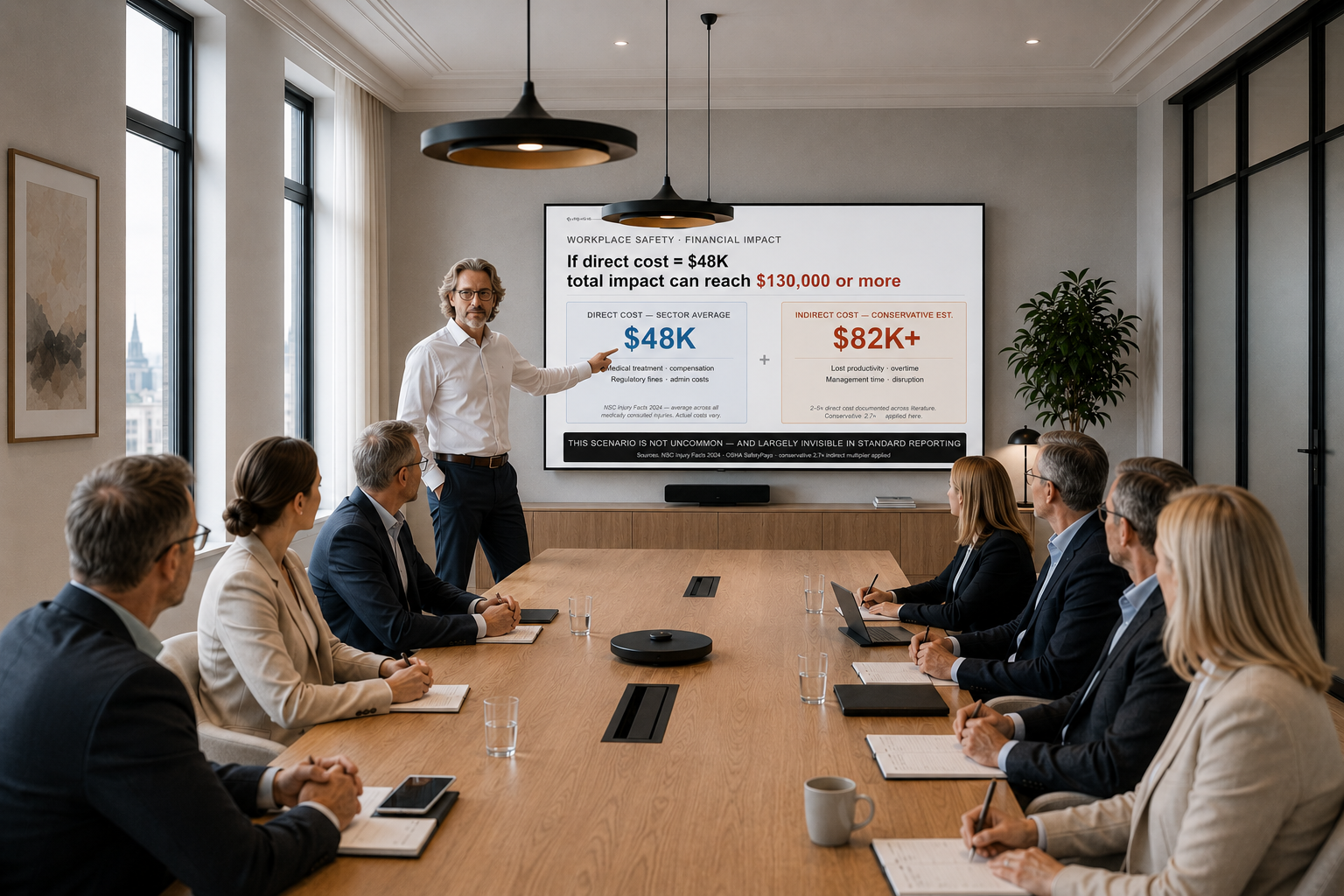
- A workplace injury hits the bottom line long after the incident itself – in absence, temp cover and lost production. And it's the few that escalate that really cost.
- Micro-training of 10–20 minutes is added onto meetings you already hold – instead of a course that takes people off the floor and is forgotten within weeks anyway.
- AC-Analytics makes safety a measurable variable – data for the board, insurers and ESG.
- It isn't about spending more money, but about spending it in a better structure.
You're already spending the money — just in the wrong structure
Most companies don’t spend too little on safety. They spend it in the wrong structure: a large annual outlay on training in knowledge that fades within months.
And in Denmark that outlay is expensive. A full course takes people off the floor mid-operation, and an hour of industrial labour costs on average DKK 427, including all employer costs.1 Worse: the investment evaporates. Emergency-response skills begin to decay measurably within 30 days of a course2 — and the typical course is a few hours of classroom teaching, its certificate valid for 24 months,3 but its skill gone long before. So you’re paying expensive Danish working time for readiness that isn’t there when it counts.
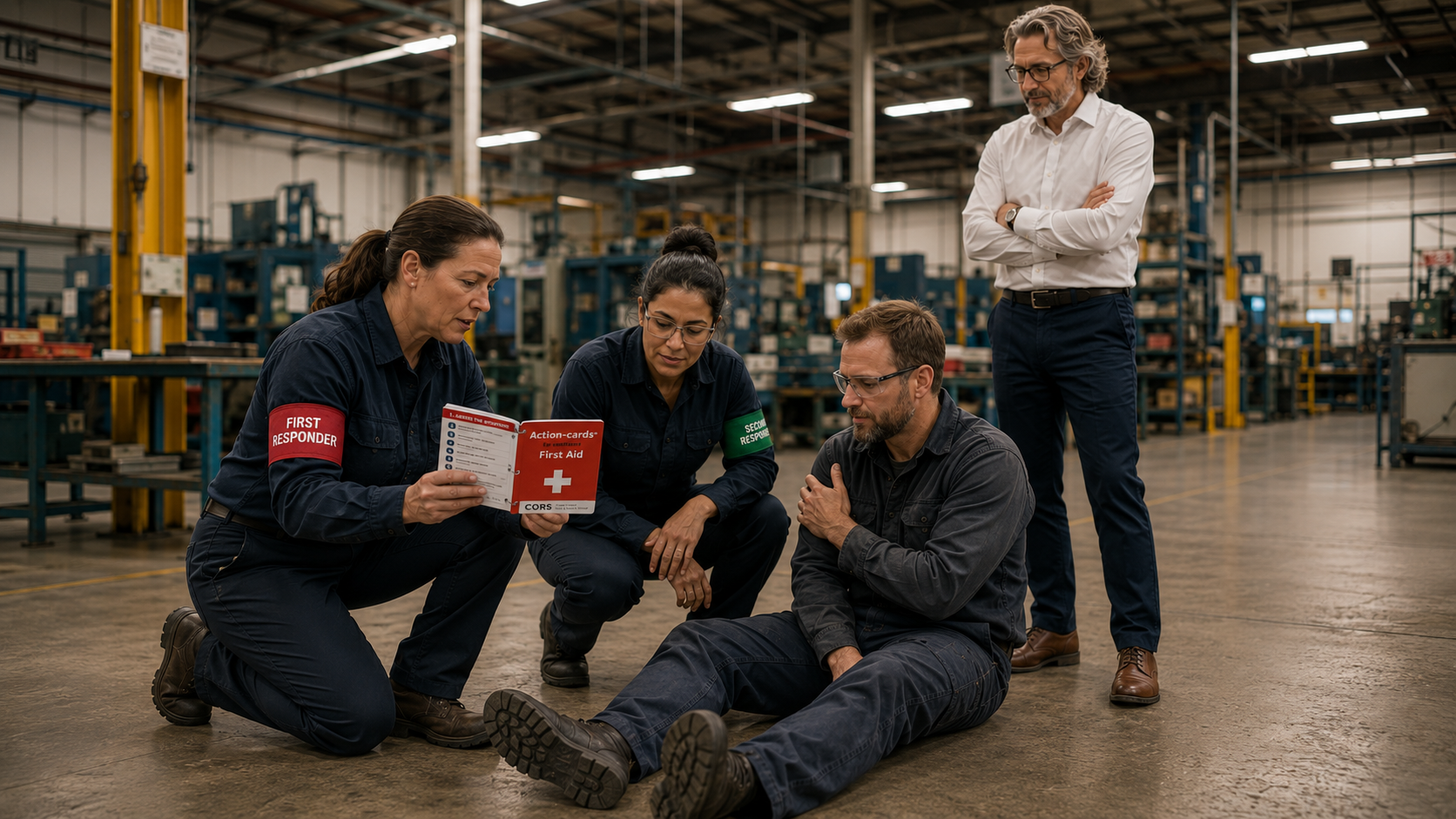
Action-cards® flips the structure: 10–20 minute micro-sessions are added onto meetings you already hold — almost no extra time out of production — and a steady rhythm keeps readiness alive instead of letting it decay. Same money, better structure.

In most of the companies we visit, the safety budget has been approved year after year without anyone asking the simple question: is the training we paid for last year still there — in the hands and heads of our people — when it really matters? In our experience, the honest answer is usually uncomfortable.
What's at stake in a 300-person company?
WORKED EXAMPLE · WHAT’S AT STAKE
Three places where the structure decides the economics:
- The system you'd otherwise buy — ~DKK 100,000–250,000/yr for an EHS platform, a safety LMS and implementation, billed per user. Action-cards® + AC-Analytics covers the same at a fraction – and for everyone (see the table below).
- The training time that evaporates — an hour of industrial labour costs on average DKK 427.1 A full course is expensive time out of production, and the skill is measurably weakened after 30 days. Micro-training appended to meetings keeps readiness alive with no production stop.
- The expensive incidents — most incidents are small; the few that escalate (long-term absence, permanent injury, loss of a key employee) each run into the hundreds of thousands. Timely readiness moves them out of the expensive category.
Documented benchmarks, not guarantees. We’re happy to build a concrete calculation for your company once we know your starting point. Full documentation in our Data & Methodology Note.
What it costs to build the same readiness — with and without Action-cards®
The honest comparison isn’t about guessing how many accidents you avoid. It’s about what it costs to have a system that actually covers everyone — all the time.
To build equivalent capability without Action-cards, you typically buy several separate systems: a learning platform (LMS) for training, an EHS platform for incident and near-miss logging, plus time for manual reporting. Publicly listed prices give an indication:
| Equivalent setup — without Action-cards® | |
|---|---|
| Corporate LMS (300 users) | ~DKK 107,000–190,000 |
| EHS / incident platform (small number of seats) | ~DKK 20,000–80,000 |
| Implementation and onboarding (amortised) | ~DKK 15,000–50,000 |
| Typical combined level | ~DKK 100,000–250,000/yr |
Action-cards® + AC-Analytics delivers the same — micro-training, incident and near-miss logging, automated PDF reporting and analytics — at a fraction, with one decisive difference: it covers everyone, not just the licensed few.
And here is the structural saving: an LMS and an EHS platform are billed per user, and the bill grows with every new employee — so much that some vendors now market themselves on “no per-user fees.” Physical cards with QR have virtually no cost per extra person. No app, no internet, no IT onboarding. The larger the team, the cheaper readiness per head.
Assumptions: the amounts are international SaaS list prices (e.g. iSpring, TalentLMS, 360Learning,
SafetyCulture) converted to kroner; the products are also sold in Denmark, and EcoOnline is Nordic.
EHS platforms are largely quote-based, so the range is indicative, not a fixed quote. Few companies
buy all three elements at top price at once; the typical combined level for comparable capability
therefore lands in this range — often with only partial coverage.9
If I authorised the purchase of forklifts that lost half their functional capacity every three months – how long would the board tolerate it?
Readiness has to be there when it counts
A system that covers everyone isn’t just cheaper — it’s also the difference between whether readiness is actually present when it counts.
Coverage is typically low. There is no legal requirement in Denmark that all employees be trained in first aid — the rules only require “the necessary measures” relative to risk and company size, in practice a few designated first-aiders.6 When something happens, the trained one is rarely the person standing there.
And you don’t need people to remember first aid by heart. You need the right action available at the moment it matters. A study of surgical crises found that cognitive aids — a card that guides step by step — remove about
75% of the critical steps otherwise missed under pressure.4 That’s what a physical Action-card does: it requires no memory, only that the card is there.
And financially, that’s exactly where it’s decided. A workplace injury hits your accounts long after the incident is over: days of absence, temp cover, lost production, and in time higher workers’ compensation insurance — the wage alone for a single day of absence is around DKK 850, before temp cover and lost production.5 Most incidents are small, but the few that escalate — long-term absence, permanent injury, the loss of a key employee — can each run into the hundreds of thousands. The direct costs behind that — absence, temp cover, lost production and replacement — are set out in our Data & Methodology Note.
How you're judged on it: LTIR and TRIR
Two metrics determine how insurers, authorities and ESG-conscious lenders assess your safety. Lost Time Injury Rate (LTIR) tracks incidents with absence days; Total Recordable Incident Rate (TRIR) records all noted injuries and is always higher. Both are measured per 100 full-time employees per year.
In Denmark, around 24 workplace accidents per 1,000 full-time employees are reported each year7 — manufacturing, transport and warehousing run above average. A worsening rate hits insurance premiums and, under CSRD and ESG reporting, access to financing, and can disqualify you from tenders. Risk assessments by our own consultancy have in some cases found accident rates five to seven times above the sector average.8
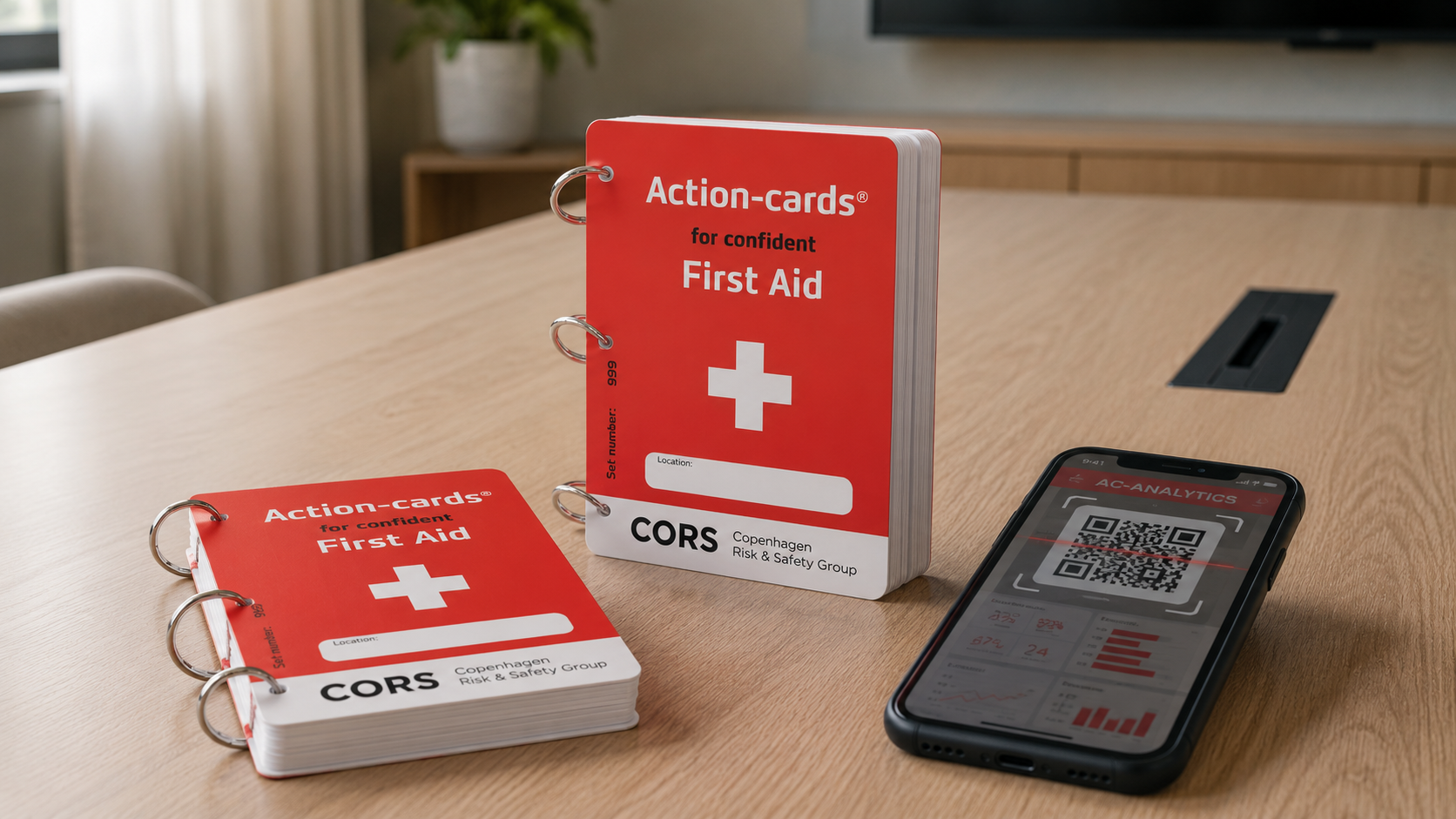
From data point to decision
AC-Analytics turns every incident, near-miss and micro-training session into a structured, auditable record that feeds your KPI reporting, ESG disclosures and insurance-renewal negotiations.
Every QR scan logs time, user and action automatically. Dashboards reveal skill gaps, near-miss patterns and performance trends. PDF reports are generated automatically for insurers and authorities.
And the reporting isn’t just automatic — it’s fast and focused. An incident report typically takes 5–10 minutes10, because only the relevant fields are filled in. Heavy EHS systems can take considerably longer, with long standardised forms and fields that are often irrelevant to the specific incident.
That’s how safety becomes a managed financial variable rather than a compliance cost — not by claiming it works, but by generating the data that proves it.
The question isn't cost — it's structure
When you can show the board that safety is a lever on lower insurance premiums, incident liability and ESG-linked financing — not a fixed cost — the question shifts from “How much does it cost?” to “How soon can we implement it?”
The answer was always there in the numbers. It just took a closer look to see it.
When we sit down with a CFO and walk through the real cost structure of a single serious incident – absence, temp cover, lost production, insurance consequences – the reaction is almost always the same: I had no idea it added up to that.
next step
See what a day could look like for your team
Tell us a little about your team, and we’ll show you an example of a team-building day and a micro-training rhythm that fits your everyday work.
On the call, you’ll get
- A concrete example of how the day runs
- Scenarios that fit your workplace
- A suggestion for how often you can train afterwards
The call is free, with no obligation.

From real life
… our staff have significantly increased their confidence, decisiveness, and ability to take action.

Anders Møller Bilander
Operations Manager at Gentofte LIFE
Learn more about Action-cards®
The solution has five parts. Here are the ones that fit team building.
First Aid Course with Action-cards®
Your team learns safe first aid with the cards – and keeps it fresh with micro-training.
Action-cards®
Physical cards that guide you step by step through 15+ scenarios. No app, no internet.
References
Every figure in this article is documented in our Data & Methodology Note for Danish operations.
1 Statistics Denmark, SAO01 (2024): total labour cost per hour worked – industry approx. DKK 427.
2 Anderson GS, Gaetz M, Masse J (2011), Scand J Trauma Resusc Emerg Med 19:11: decline in practical skills within 30 days (257 certified first-aiders).
3 Danish First Aid Council / Dansk Folkehjælp: cardiac-arrest/CPR basic course 4 hours; certificate valid 24 months.
4 Arriaga AF et al. (2013), N Engl J Med 368:246-53: cognitive aids remove ~75% of omission errors in simulated crises.
5 Danish Working Environment Authority, cost of absence: employer gross wage cost per sick day approx. DKK 835–885 (wage only).
6 Danish Working Environment Authority, Executive Order on the Performance of Work, §23: requires “the necessary first-aid measures” – not a general training requirement for all employees.
7 Confederation of Danish Employers (DA), accident statistics 2023: approx. 24 reported workplace accidents per 1,000 full-time employees.
8 Action-cards’ / CORS Group own risk assessments (2025): accident rates five to seven times above sector average. Own data.
9 System prices (public list prices): LMS 300 users – iSpring ~$16,050/yr, TalentLMS ~$19,800/yr, 360Learning ~$29,000/yr; SafetyCulture Premium ~$24/user/mo; EcoOnline (Nordic) flat pricing / quote.
10 Reporting time ~5–10 min per incident: Action-cards’ own data.